What Facebook Event Marketing Looked Like in 2017 vs. Now
If you were promoting events on Facebook a decade ago, the playbook was simple: build a Facebook Events page, share it with your followers, let attendees RSVP, and watch the algorithm do the rest. Facebook's organic reach pushed your event into friends of friends, the Events feature sent reminders, and ticket sales followed.
That playbook is gone. Facebook Pages now reach a small fraction of their followers organically. The Facebook Events feature, while still functional, has been significantly deprioritized in Meta's product roadmap. Attendee RSVPs carry less predictive weight than they used to. The organic-reach strategy that powered event marketing in the 2010s simply doesn't work at scale in 2026.
What replaced it is Meta's paid advertising ecosystem across Facebook and Instagram, and when it's run well, it's still one of the most effective ways to sell tickets to live events. This guide covers what actually works now: how to structure Meta ad campaigns for events, which creative formats convert, how to target buyers across Facebook and Instagram, and how to measure whether any of it is paying off.
Start with the Reality: Paid Is the Strategy Now
Before any tactical advice, be honest with yourself about the operating environment. Organic reach on Facebook Pages sits in the low single digits for most brands. A post that goes out to 10,000 followers will be seen by a few hundred of them, at best. Instagram organic reach is slightly better but has followed the same downward trend.
Meta is a pay-to-play platform for all practical purposes. Treat your Pages and Events as supporting infrastructure (a landing page, a place for buyers to find hours and directions, a signal of legitimacy), but build your actual acquisition strategy around paid Meta ads. Budget accordingly. Most festival-scale events running at full effort allocate somewhere between 40 and 60 percent of their total marketing spend to Meta ads alone.
The good news: when paid social is run thoughtfully, it's still one of the best-performing event channels available. Meta's audience tools, particularly Custom Audiences and Lookalike Audiences, are hard to replicate anywhere else. The core fundamentals you'll learn here still work. They just require an honest budget commitment to get real results.
Set Up Tracking First, Always
The first thing to get right isn't an ad. It's the tracking layer underneath every ad you'll eventually run. Without this, you're gambling in the dark, and Meta can't optimize for outcomes it can't see.
Three things to have in place before you spend a dollar:
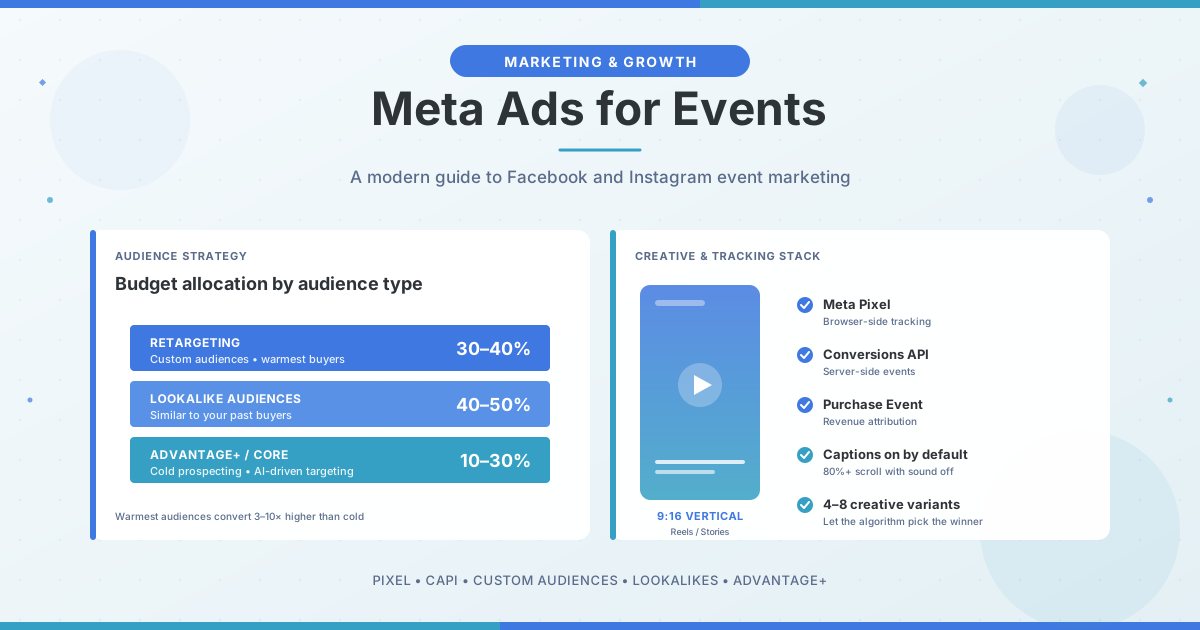
- Meta Pixel on your ticket pages. The Pixel is Meta's tracking script. It watches visitor behavior, feeds data back to Meta Ads Manager, and lets the algorithm optimize your ads for people likely to buy, not just people likely to click. A well-configured Pixel is the single highest-leverage setup decision you'll make.
- Conversions API (CAPI). Since iOS 14 privacy changes in 2021, pixel-only tracking has been degraded. CAPI is the server-side complement: instead of relying only on the browser pixel, it sends conversion events directly from your server to Meta. Running both together dramatically improves attribution accuracy.
- Standard purchase event configured. Make sure Meta is tracking a proper "Purchase" conversion event with ticket revenue as the value. Optimizing for clicks is much less effective than optimizing for purchases, and Meta can only optimize for what you track correctly.
Big Tickets ticket pages support native Meta Pixel integration, so organizers can drop in their Pixel ID and have standard events (ViewContent, AddToCart, Purchase) fire automatically. Attribution data then flows through to both your Meta Ads Manager and the Big Tickets reporting suite, so you can compare Meta-reported conversions against Big Tickets' own order data. When the two disagree (they will, slightly), Big Tickets has the ground truth on actual ticket sales.
Meta's Three Audience Types, Used in the Right Order
Meta offers three primary audience types for ad targeting. The mistake most organizers make is using them equally; the right approach is to use them in sequence, with most of your budget concentrated where the math works best.
- Custom Audiences (your warmest buyers). Upload your email list, retarget people who visited your ticket pages in the last 30–90 days, and create audiences from people who engaged with your Instagram or Facebook profile. These audiences convert at 3–10× the rate of cold audiences. Start here every time, and put a meaningful portion of your budget into Custom Audiences before you spend a dollar on new acquisition.
- Lookalike Audiences (your warm-adjacent prospects). Feed Meta a list of your past buyers and ask it to find similar people. A 1% Lookalike is tight and high-intent; a 5–10% Lookalike is broader and better for scale. For festivals and concerts, Lookalike Audiences are often the single best-performing targeting option for acquiring new buyers.
- Core Audiences and Advantage+ (cold prospecting). The 2017 version of Meta ads required you to manually set detailed interest and demographic targeting. In 2026, most sophisticated advertisers have shifted to Advantage+ campaigns, Meta's AI-driven campaign type that handles targeting automatically based on your pixel data and creative. Manual interest targeting (Core Audiences) still has a role for very specific audiences (niche genres, unusual event types), but Advantage+ will often outperform it once your pixel has enough conversion data.
Budget allocation that works for most festival and concert campaigns: 30–40% retargeting (Custom Audiences), 40–50% Lookalike Audiences, 10–30% Advantage+ or Core Audience prospecting. Adjust based on your funnel stage and historical performance.
Creative: What Actually Works in 2026
The creative side of Meta ads has evolved as much as the targeting side. Four principles that hold up in 2026:
- Vertical video, always. Reels dominate both Facebook and Instagram feeds. Horizontal video gets cropped awkwardly on mobile, which is where 90%+ of your impressions will happen. Shoot for 9:16 vertical (1080×1920).
- Hook in the first three seconds. The old "first 10 seconds" advice has tightened. Users scroll fast, and if your opening frame doesn't stop them, nothing else in the video matters. Open with motion, a recognizable face, a clear benefit, or genuine energy. Avoid static title cards and slow builds.
- Captions on by default. Most users scroll with sound off, and even users with sound on benefit from captions. Every video should have burned-in or styled captions. No captions means lost conversions.
- Multiple creatives, not one. Meta's algorithm performs best when given 4–8 creative variations per campaign to test. A single ad that you spent three weeks producing will almost always underperform four quick-turn variations that let the algorithm find the winner.
What to feature in event creative: past attendee footage, artist/lineup announcements, behind-the-scenes content, walkthroughs of what the event feels like, and genuine moments rather than polished brand videos. Authentic content consistently outperforms highly produced content on Meta, especially for music, festival, and experiential event audiences.
Campaign Structure: Keep It Simple
One of the most common mistakes in Meta ads is over-segmenting campaigns into dozens of ad sets with tiny budgets. Meta's algorithm needs data volume to optimize, and splitting a $5,000 budget across 15 ad sets starves every one of them.
A clean structure for most event campaigns:
- Retargeting campaign. One campaign, one to three ad sets (site visitors, cart abandoners, past buyers). Multiple creative variants per ad set.
- Lookalike acquisition campaign. One campaign, two to three ad sets (e.g., 1% Lookalike, 3% Lookalike, 5% Lookalike). Same creative rotation across all.
- Advantage+ campaign. One campaign with Meta's AI handling audience and placement optimization. Strong candidate for most of your "cold" budget.
Three campaigns, total. Each with meaningful budget concentrated where the data is. Let each campaign run at least 7–14 days before making judgments on performance; Meta's learning phase requires time and volume to stabilize.
Instagram Is Not Just "Facebook with Pictures"
For many event types, Instagram now drives more ticket sales than Facebook does. If you've been treating Instagram as an afterthought, you're underinvesting in what may be your strongest Meta surface.
Where Instagram outperforms Facebook:
- Younger audiences. Under-35 audiences spend dramatically more time on Instagram than on Facebook. Music festivals, concerts, and experiential events all benefit.
- Visual content. The platform was built for photos and short video; visual event content naturally fits the feed.
- Creator and artist partnerships. Instagram is where most artists and creators manage their audiences. Artist collaboration posts, Reels takeovers, and Stories from performers drive real traffic.
- Story ads and Reels ads. These full-screen, vertical-video formats convert at higher rates than standard feed placements for many event campaigns.
Where Facebook still wins:
- Older audiences. 40+ audiences still spend meaningful time on Facebook and respond well to Facebook-specific placements.
- Longer-form content. Facebook's feed tolerates more text and more context, which helps for complex events or first-year events that need explaining.
- Local community reach. Facebook Groups and local pages still drive awareness in a way Instagram doesn't really replicate.
For most festival and live event campaigns, you should be running both placements within Meta Ads Manager and letting the algorithm allocate budget to whichever performs better. Don't manually split IG and FB budgets; let Meta do that work.
Optimize Your Event's Social Share Previews
One detail most organizers overlook: what does your ticket page look like when someone shares it on Facebook, Instagram, or in a text message? If the preview is broken, generic, or unattractive, you lose sales from every single shared link, whether shared organically by an excited buyer or posted by a partner in a newsletter.
The technical piece here is Open Graph (OG) tags: meta tags on your ticket page that tell social platforms which title, description, and image to use for the preview card. A well-optimized OG setup means a shared ticket link shows your event's name, date, a compelling image, and a clear call to action. A broken setup shows a generic platform URL with no image.
Test your event's share preview before you launch by using Meta's Sharing Debugger (available in Meta's developer tools). Paste your ticket page URL, see what Facebook and Instagram will render, and fix any missing fields before your audience starts sharing.
Measure What Matters (and What You Can't)
One uncomfortable truth about Meta ads in 2026: attribution is imperfect. Since iOS 14's privacy changes and ongoing cookie deprecation, the exact path from ad click to ticket purchase is harder to trace than it was in 2019. Meta will report conversions that your pixel tracked. Your ticketing platform will report actual orders. The numbers rarely match exactly.
How to think about this productively:
- Use Meta's reported numbers directionally, not absolutely. If Meta says a campaign drove 500 purchases and your Big Tickets order report shows 420 Meta-attributed sales, the truth is somewhere in the middle. Use the trend, not the specific number.
- Let Big Tickets' reporting be your source of truth for revenue. Meta optimizes against its own reported conversion numbers; that's fine for campaign decisions. But when you're calculating actual ROI, use your Big Tickets order data as the ground truth.
- Run incrementality tests periodically. For larger campaigns, pause Meta ads in a small geo or time window and measure the drop in ticket sales. This tells you what Meta is actually contributing, which is often different from what Meta reports it contributes.
- Track Return on Ad Spend (ROAS), not just cost per conversion. A campaign at $15 cost-per-purchase looks great until you realize the tickets were $12. ROAS forces you to look at revenue, not just transactions.
The Short Version
Run Meta Pixel and Conversions API together. Put most of your budget into retargeting and Lookalike Audiences, not cold prospecting. Shoot vertical video with captions and multiple variants. Consolidate campaigns rather than fragmenting them. Don't ignore Instagram. Fix your Open Graph tags before launch. And don't rely on Meta's numbers as the only source of truth.
Done well, Meta ads are still one of the most effective ticket sales channels available to festival and live event organizers. Done badly, they're a reliable way to burn budget. The difference is almost entirely about setup, tracking, and creative discipline. The algorithm is not the problem; the work done before the algorithm sees your campaign is what separates the events that sell out from the ones that don't.
Ready to Run a Smarter Event?
Big Tickets helps festivals, fairs, concerts, and live events sell more tickets, streamline operations, and deliver a better attendee experience. No subscriptions, no setup fees.
Request a Demo